
Find a photo by describing it
You remember a dog in the snow, but not its filename. Give the example a sentence and it ranks the photos that best match. It searches a small collection on your laptop, without an API key or GPU.
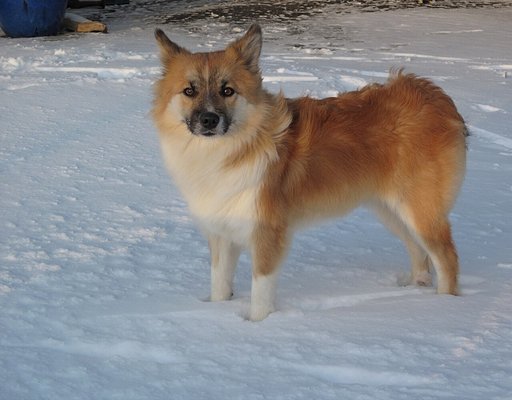
First match for a dog playing in the snow:
First match for a city street at night:
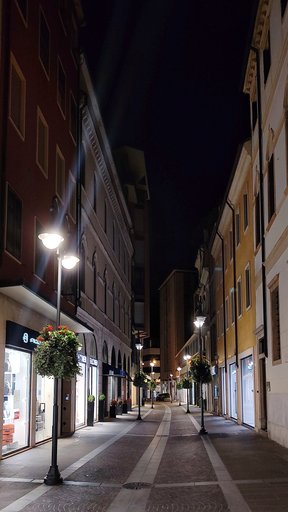
These are the first matches reported for the included collection. They illustrate similarity, not exact understanding: the dog is standing in snow, even though the query says "playing". Photo sources and licenses.
Run it
You need uv and
Git LFS. Run git lfs pull from the repository root (sail-examples/) to
fetch the photos if your checkout does not have them. Then run:
uv run multimodal/search-images-by-text/main.py
The first run installs the packages and downloads about 600 MB of model weights from Hugging Face. Later runs reuse the cached weights. No account is required.
The output lists the top three photos for each query and evaluates retrieval against the collection's captions. For the included 53 photos, 52 captions find their own photo first; all 53 find it in the top five. These results describe this collection, not accuracy on every photo library.
Output
The newest capture appears first. Older output stays here when a result changes.
Recorded output · Sail 0.7.3
Captured on Sail 0.7.2, 0.7.3. Latest capture: 2026-11-05, Python 3.12.14.
The example has changed since this capture. Rerun it to refresh the output.
a dog playing in the snow
  1. 0.279  dog-snow.jpg
  2. 0.254  fox.jpg
  3. 0.225  snow-trees.jpg
a sailboat on the water
  1. 0.268  sailboat-bay.jpg
  2. 0.254  sailboat.jpg
  3. 0.243  beach-tropical.jpg
a cat asleep
  1. 0.303  cat-sleeping-orange.jpg
  2. 0.295  cat-sleeping-curled.jpg
  3. 0.259  cat-tabby.jpg
a city street at night
  1. 0.307  street-night.jpg
  2. 0.234  bridge-night.jpg
  3. 0.196  bicycle-snow-night.jpg
breakfast on a plate
  1. 0.283  food-english-breakfast.jpg
  2. 0.265  food-pizza.jpg
  3. 0.242  food-caesar-salad.jpg
+--------+------------------+-----------+
|captions|       recall_at_1|recall_at_5|
+--------+------------------+-----------+
|      53|0.9811320754716981|        1.0|
+--------+------------------+-----------+
Python code
main.py212 lines
# /// script
# requires-python = ">=3.12"
# dependencies = [
# "certifi==2026.10.19",
# "pysail==0.7.3",
# "pyspark-client==4.1.3",
# "pyarrow==26.0.0",
# "pandas==3.0.6",
# "numpy==2.5.4",
# "onnxruntime==1.31.1",
# "tokenizers==0.22.1",
# "huggingface-hub==0.36.0",
# "pillow==13.0.0",
# ]
# ///
"""Search a folder of photos with plain-language text, using CLIP inside the engine.
CLIP has two encoders that map images and text into the same vector space. Both run in
`mapInArrow`, the vectors are stored as ARRAY<FLOAT>, and `vector_cosine_similarity` ranks the
photos for each query. Each photo has a written caption, which gives a retrieval score in SQL.
"""
import atexit
import csv
import shutil
import tempfile
from pathlib import Path
import pyarrow as pa
from pyspark.sql import DataFrame, SparkSession, Window
from pyspark.sql import functions as F
# CLIP ViT-B/32, with the image and text encoders exported to ONNX as two models.
VISION_REPO = "Qdrant/clip-ViT-B-32-vision"
VISION_REVISION = "e0c24ed0fa57fa3e4f97f30de74c51d944036ace" # pinned: every run uses the same weights
TEXT_REPO = "Qdrant/clip-ViT-B-32-text"
TEXT_REVISION = "48ca1db27cb4063eb311ec2aa7f087a808112876"
CONTEXT_LENGTH = 77 # CLIP reads at most 77 tokens
INFERENCE_BATCH_SIZE = 16 # bound model tensors independently of Arrow input batch size
IMAGES = Path(__file__).resolve().parent / "images" # sources and licenses: images/CREDITS.md
QUERIES = [
"a dog playing in the snow",
"a sailboat on the water",
"a cat asleep",
"a city street at night",
"breakfast on a plate",
]
IMAGE_COLUMNS = "file string, embedding array<float>"
IMAGE_SCHEMA = pa.schema([("file", pa.string()), ("embedding", pa.list_(pa.float32()))])
TEXT_COLUMNS = "query_id long, embedding array<float>"
TEXT_SCHEMA = pa.schema([("query_id", pa.int64()), ("embedding", pa.list_(pa.float32()))])
def temp_dir(prefix: str) -> str:
"""A temporary directory that is removed when the process exits."""
path = tempfile.mkdtemp(prefix=prefix)
atexit.register(shutil.rmtree, path, ignore_errors=True)
return path
def photo_catalog() -> list[tuple[str, str, str]]:
"""(path, file, caption) for every photo, from images/captions.csv."""
with open(IMAGES / "captions.csv", newline="") as f:
return [(str(IMAGES / row["file"]), row["file"], row["caption"]) for row in csv.DictReader(f)]
def unit_rows(vectors):
"""Scale each row to length 1, so cosine similarity is a dot product."""
import numpy as np
return vectors / np.clip(np.linalg.norm(vectors, axis=1, keepdims=True), 1e-12, None)
def embed_images(batches):
"""mapInArrow function: everything before the loop runs once per partition."""
import numpy as np
import onnxruntime as ort
from huggingface_hub import hf_hub_download
from PIL import Image
# Download where the task runs (cached per machine), so this also works on cluster workers.
model_path = hf_hub_download(VISION_REPO, "model.onnx", revision=VISION_REVISION)
options = ort.SessionOptions()
options.intra_op_num_threads = 1 # the engine runs partitions in parallel already
session = ort.InferenceSession(model_path, sess_options=options, providers=["CPUExecutionProvider"])
mean = np.array([0.48145466, 0.4578275, 0.40821073], dtype=np.float32)
std = np.array([0.26862954, 0.26130258, 0.27577711], dtype=np.float32)
def preprocess(path):
# CLIP's preprocessing: shortest side to 224 (bicubic), center crop 224, normalize.
with Image.open(path) as image:
image = image.convert("RGB")
# The shorter side becomes exactly 224; the longer side is scaled and truncated, as transformers does.
short, long = sorted(image.size)
resized = (224, int(224 * long / short))
image = image.resize(resized if image.width <= image.height else resized[::-1], Image.BICUBIC)
left, top = (image.width - 224) // 2, (image.height - 224) // 2
image = image.crop((left, top, left + 224, top + 224))
return ((np.asarray(image, dtype=np.float32) / 255.0 - mean) / std).transpose(2, 0, 1)
for input_batch in batches:
for start in range(0, input_batch.num_rows, INFERENCE_BATCH_SIZE):
batch = input_batch.slice(start, INFERENCE_BATCH_SIZE)
paths = batch.column("path").to_pylist()
if not paths:
continue
(vectors,) = session.run(
["image_embeds"], {"pixel_values": np.stack([preprocess(p) for p in paths])}
)
yield pa.RecordBatch.from_pydict(
{"file": [Path(p).name for p in paths], "embedding": unit_rows(vectors).tolist()},
schema=IMAGE_SCHEMA,
)
def embed_texts(batches):
"""mapInArrow function for the text encoder."""
import numpy as np
import onnxruntime as ort
from huggingface_hub import hf_hub_download
from tokenizers import Tokenizer
model_path = hf_hub_download(TEXT_REPO, "model.onnx", revision=TEXT_REVISION)
tokenizer_path = hf_hub_download(TEXT_REPO, "tokenizer.json", revision=TEXT_REVISION)
options = ort.SessionOptions()
options.intra_op_num_threads = 1
session = ort.InferenceSession(model_path, sess_options=options, providers=["CPUExecutionProvider"])
tokenizer = Tokenizer.from_file(tokenizer_path)
tokenizer.enable_truncation(CONTEXT_LENGTH)
# Fixed-length padding makes a row's vector independent of the other rows in its batch.
end_of_text = "<|endoftext|>"
tokenizer.enable_padding(
length=CONTEXT_LENGTH, pad_id=tokenizer.token_to_id(end_of_text), pad_token=end_of_text
)
for input_batch in batches:
for start in range(0, input_batch.num_rows, INFERENCE_BATCH_SIZE):
batch = input_batch.slice(start, INFERENCE_BATCH_SIZE)
texts = batch.column("text").to_pylist()
if not texts:
continue
encodings = tokenizer.encode_batch(texts)
feeds = {
"input_ids": np.array([e.ids for e in encodings], dtype=np.int64),
"attention_mask": np.array([e.attention_mask for e in encodings], dtype=np.int64),
}
(vectors,) = session.run(["text_embeds"], feeds)
yield pa.RecordBatch.from_pydict(
{"query_id": batch.column("query_id"), "embedding": unit_rows(vectors).tolist()},
schema=TEXT_SCHEMA,
)
def caption_recall(ranked: DataFrame) -> DataFrame:
"""Score each caption against its own photo, even when captions repeat."""
matches = ranked.filter(F.col("target_file").isNotNull() & (F.col("file") == F.col("target_file")))
return matches.agg(
F.count("*").alias("captions"),
F.avg((F.col("rank") == 1).cast("double")).alias("recall_at_1"),
F.avg((F.col("rank") <= 5).cast("double")).alias("recall_at_5"),
)
def run(spark: SparkSession) -> dict[str, DataFrame]:
catalog = photo_catalog()
photos = spark.createDataFrame(catalog, "path string, file string, caption string")
# Embed the photos once and save the vectors: every query below reads them back.
vectors_path = temp_dir("image-vectors-")
photo_paths = photos.select("path").repartition(2)
photo_paths.mapInArrow(embed_images, IMAGE_COLUMNS).write.mode("overwrite").parquet(vectors_path)
image_vectors = spark.read.parquet(vectors_path).withColumnRenamed("embedding", "image_vec")
# Free-text queries, plus each photo's caption to score retrieval.
query_rows = [(i, text, None) for i, text in enumerate(QUERIES)]
query_rows.extend((i + len(QUERIES), caption, file) for i, (_, file, caption) in enumerate(catalog))
queries = spark.createDataFrame(query_rows, "query_id long, text string, target_file string")
query_vectors = queries.mapInArrow(embed_texts, TEXT_COLUMNS).withColumnRenamed("embedding", "text_vec")
scored = query_vectors.crossJoin(image_vectors).select(
"query_id",
"file",
F.expr("vector_cosine_similarity(text_vec, image_vec)").cast("double").alias("score"),
)
rank = F.row_number().over(Window.partitionBy("query_id").orderBy(F.desc("score"), "file"))
ranked = scored.withColumn("rank", rank).join(queries, "query_id").join(photos.drop("path"), "file")
top3 = ranked.filter((F.col("query_id") < len(QUERIES)) & (F.col("rank") <= 3)).select(
"query_id", "text", "rank", "file", "score"
)
# A caption query is a hit at k when the photo it describes ranks in the top k.
recall = caption_recall(ranked)
return {"top3": top3.orderBy("query_id", "rank"), "recall": recall}
if __name__ == "__main__":
from pysail.spark import SparkConnectServer
server = SparkConnectServer()
server.start()
_, port = server.listening_address
spark = SparkSession.builder.remote(f"sc://localhost:{port}").getOrCreate()
results = run(spark)
for query_id, query in enumerate(QUERIES):
print(query)
for row in results["top3"].filter(F.col("query_id") == query_id).collect():
print(f" {row['rank']}. {row['score']:.3f} {row['file']}")
results["recall"].show()
spark.stop()
server.stop()
What is CLIP, and what does Sail do?
CLIP is a model that turns pictures and text into comparable lists of numbers, called embeddings. A photo and a sentence with similar content should have similar embeddings. This example runs CLIP through ONNX Runtime on the CPU.
Sail runs the Python functions that compute those embeddings, stores the photo embeddings in Parquet, and ranks matches with SQL. CLIP supplies the image and text representations; Sail handles the data workflow.
The expression to keep
The script scores each query against each photo with:
vector_cosine_similarity(text_vec, image_vec)
Larger values rank earlier. The source code uses a window function to keep three matches per query. It also measures how often each photo's caption retrieves that photo.
Try one change: search for a red car
multimodal/search-images-by-text/main.py:
Linemain.py · original lines 42 to 48 QUERIES = [
"a dog playing in the snow",
"a sailboat on the water",
"a cat asleep",
"a city street at night",
"breakfast on a plate",
+ "a red car",
]
Rerun uv run multimodal/search-images-by-text/main.py from the repository root (sail-examples/). The output now includes three matches
for a red car; open those files in multimodal/search-images-by-text/images/ to compare them.
How it works
- A table of paths.
multimodal/search-images-by-text/images/captions.csvlists each photo and its caption. The photos become a DataFrame with onepathper file. Each task opens only the files in its own rows. - Embed the photos.
mapInArrowdownloads the image encoder where the task runs (cached per machine) and loads it once per partition. It applies CLIP's preprocessing: the shorter side is resized to 224 pixels, center-cropped, and normalized. A check against the transformers 4.57.1 CLIP image processor gave the same pixels. Each model call handles at most 16 photos. The function returns one vector per photo, scaled to length 1 and stored asARRAY<FLOAT>, the type the vector functions accept. - Save once. The photo vectors are written to Parquet and read back, so the queries never run the image encoder again.
- Embed the text. A second
mapInArrowruns the text encoder. Model calls handle at most 16 queries, each padded to CLIP's fixed length of 77 tokens, so its vector does not depend on which other queries share its batch. - Search in SQL. A cross join of queries and photos is scored with
vector_cosine_similarity, and a window function ranks the photos per query. - Measure in SQL. For each caption query, its recorded target filename gives recall at 1 and at 5. Repeated captions remain separate queries with their own targets.
The cross join scores every query against every photo. Check that this query-photo product fits your memory and runtime limits before increasing the gallery size. This example does not build or query a vector index.
Use your own photos
Point IMAGES at your own folder with a captions.csv, or build the photos DataFrame from any list of files, and change QUERIES. The paths must be readable from wherever the UDF runs: local paths on one machine, object storage URLs (read with a client such as fsspec) on a cluster. Without captions, drop the recall query. A file that cannot be decoded raises an error and fails the job. To record such files and keep going, catch the error per file and return a status column, as the OCR example does.
Photos
All 53 photos are from Wikimedia Commons. Each is either dedicated to the public domain under CC0, or in the public domain as a work of the US federal government; two of the government photos also carry a CC BY 2.0 tag. Each was resized to at most 512 pixels on its longer side. images/CREDITS.md lists every photo's source page, creator and license.